Trustworthy AI Agents: Trust the Mechanism, Not the Output
I trust an AI agent because I can read how it reached an answer, not because the answer looks good. Here's the engineering behind that.
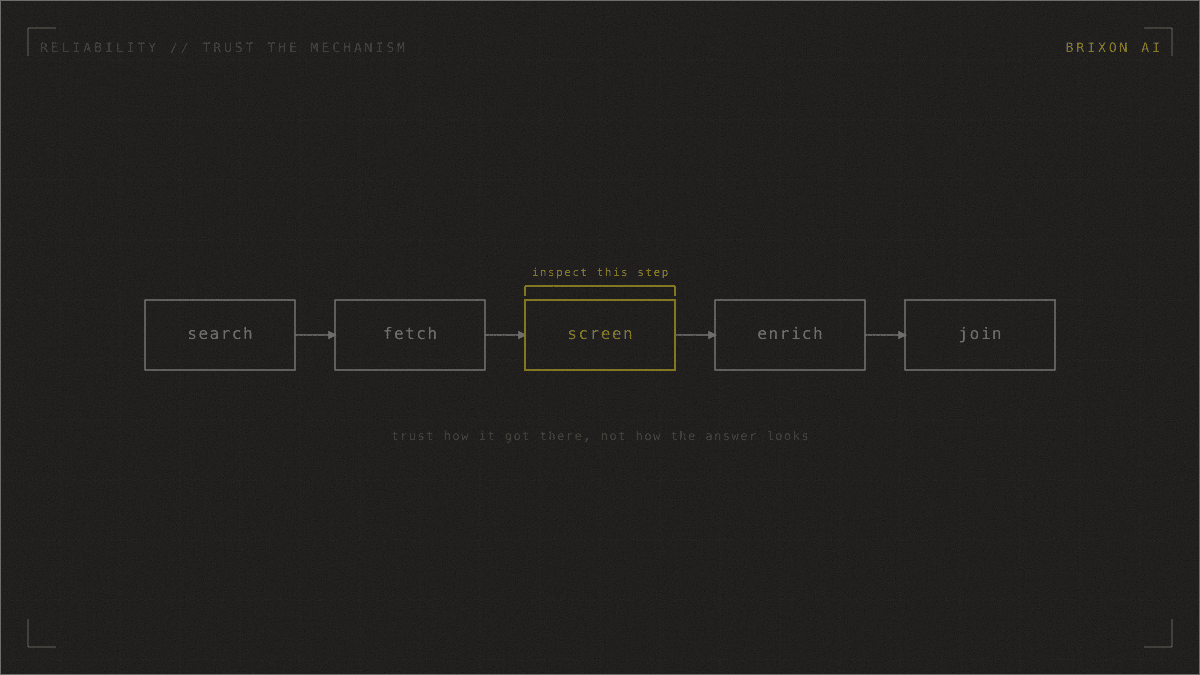
A trustworthy AI agent earns your trust through a verifiable mechanism: the steps it took to reach an answer, not the answer itself. The agent's process has to be legible (you can read the steps it took), faithful (the plan you can read is the plan that actually ran), and stable (adding a requirement doesn't make it drift from what you asked). A capable model produces convincing output whether or not it did the work underneath, so output quality alone is never proof of trust. The verifiable mechanism is what gives you that proof.
That reframing is the whole idea, and it's how I judge any agent, whether my team built it or a vendor is trying to sell it to me. The rest of this article shows how it works, using one concrete example: a research agent asked to map every competitor in a category.
Why does trust, not capability, decide whether an AI agent ships?
Because most teams can already get an agent to produce a polished answer. Far fewer can prove it's trustworthy, and the gap shows in the numbers. Gartner forecast in June 2025 that more than 40% of agentic AI projects will be canceled by the end of 2027, citing escalating costs, unclear business value, and inadequate risk controls. PwC's April 2025 survey of 308 US executives found trust ranked a top-three barrier to AI agents, and that trust drops sharply for high-stakes work: respondents trusted agents with data analysis (38%) far more than with financial transactions (20%).
Developers are just as cautious. In the 2025 Stack Overflow Developer Survey, 46% of developers said they distrust the accuracy of AI tools, against 33% who trust it. Among experienced developers, only 2.6% "highly trust" AI output, which the survey reads as "a widespread need for human verification for those in roles with accountability." The pattern matches what I see. Capability is no longer the blocker; verifiable trust is. It's the same reason I argue you should stop babysitting AI agents and engineer the verification in instead.
What makes an AI agent trustworthy?
Three properties make a mechanism trustworthy. They hold whether you're building the workflow or buying it.
Legible: you can read the process the agent followed. You should be able to see the exact sequence of steps the agent took: what it searched, what it retrieved, what it filtered out, what it combined. Legibility lets a human spot-check the work ("it never searched the regulatory filings, so I don't trust that column") and lets a second agent run a critique pass over the steps. The opposite is the black box: an answer with no visible derivation.
Faithful: the plan you can read is the plan that ran. A system can narrate a plan as prose and then produce its answer through a different path you never see. The strong version closes that gap. The plan is the thing that executes, so there's no daylight between the description and the behaviour. As James Brady of Elicit put it in a 2025 engineering talk on verifiable agents, the plan is "literally the plan which is executable," not a representation of a plan. "Did it actually do what it said?" stops being a matter of trust and becomes a matter of fact.
Stable: adding a requirement doesn't make it drift. Real work comes in layers. You get a first answer, then you want to add to it. With many systems, that follow-up is where trust leaks. The model drifts, loses part of the original request, or lets the new requirement bleed into and change the old results, often forcing a start-over that throws away work you already validated. A stable mechanism lets you add without disturbing what's there: everything you checked stays intact, and only the genuinely new work is new.
Legible, faithful, stable. When a mechanism has all three, I can stand behind it. Miss any one and you're back to hoping.
Why can't you trust the output alone?
Because as models improve, this problem gets worse. A weak model produces output that looks weak, so you distrust it for the right reasons. A strong, modern model produces output that looks excellent whether or not it did the work, because fluency is cheap now. A confident, plausible answer is what a capable model returns when it has done painstaking research, and also when it has quietly skipped steps or guessed at a number. I've written before about agents that are confidently wrong for exactly this reason.
So output quality and trustworthiness are two different axes, and the dangerous quadrant is high apparent quality with low verifiability: a beautiful answer you cannot check. This bites mid-market companies hardest. They rarely have the audit function a large enterprise uses to distrust outputs by default. The polished answer lands on a desk, it looks right, it gets used, and there was no mechanism in between to tell "looks right" apart from "is trustworthy."
How do you make an agent's mechanism verifiable?
You move it deliberately along a spectrum, as far as your stakes require. There's no binary between "black box" and "trustworthy." Most teams sit somewhere on that spectrum without ever choosing consciously: a raw prompt (process invisible), a structured prompt (guided but unverifiable), a written plan you can read (inspectable, but separate from what runs), a plan that is itself executed (legible and faithful in one artifact), and, at the far edge, a formal domain-specific language. The goal isn't the far end. It's to move on purpose. Brady's team built such a language and spent most of their talk explaining why most teams should not copy it.
You can get most of the way to legible, faithful, and stable with conventional engineering. Three moves do the bulk of the work:
- Make the plan an artifact, not a story. Have the system emit its plan as a readable list of concrete steps, separate from its prose. Once the plan is a thing rather than a narration, a human can read it and a second agent can critique it.
- Re-derive from the top, then cache what's unchanged. When you add a layer, re-run the whole answer from the start so the new requirement can't silently break the old results, and cache anything whose inputs haven't changed, so only new work actually runs. That's what makes stability practical.
- Put a boundary between user input and your credentials. Wall off whatever a user types from the keys, data, and model access underneath. It's a security move and a trust move at once.
The industry is converging on the first two. LangChain's State of Agent Engineering report, based on 1,340 responses gathered in late 2025, found that 94% of teams with agents in production have some form of observability in place, and 71.5% have full tracing, because, as the report puts it, "without visibility into how an agent reasons and acts, teams can't reliably debug failures, optimize performance, or build trust." Quality, not cost, was the top barrier to getting agents into production, named by 32% of respondents.
What does a trustworthy agent look like in practice?
Take a job a mid-market team actually hands to an agent: "find the companies investing in our category; for each, pull their products, partnerships, and how they've engaged with regulators; give me a table for the leadership meeting." This is a good test because the output is easy to fake. A strong model produces a clean, authoritative-looking table in one pass, and you can't tell whether each cell came from a real source or a confident guess.
A trustworthy mechanism behaves differently. First it does not answer. It asks a clarifying question (the whole category or one segment?) because the wrong interpretation is the first way a research task silently goes wrong. Then every move is written down as an explicit plan you can read: search sources, fetch full documents rather than snippets, screen down to real matches, pull the detail on each organisation, join it into the table. Because that plan is a real sequence and not a narration, you can spot a gap yourself ("it never pulled the filings") and a second agent can critique it for missed sources.
Then you add a layer: "now also map the regulators, and show how each company interacted with them." In a stable mechanism, the searches and screening you already endorsed stay identical, reused from cache, and only the new work is new. You went deeper without re-validating what you already trusted. The third revision is as trustworthy as the first because it was built on top of it, leaving it untouched.
How do you match the mechanism to the stakes?
You spend on trustworthiness where it earns its keep, because it has a cost. Demanding a fully legible, re-derivable mechanism for a throwaway internal lookup is over-engineering. Shipping a raw-prompt black box for a board- or compliance-facing decision is the opposite mistake, and the more expensive one. The discipline is one question, asked before you build or buy: what does being wrong here cost?
The data shows buyers already grade this way. PwC's executives trusted agents with low-stakes analysis far more than with financial transactions. The mistake most teams make is uniform effort: over-building the trivial, under-building the consequential. And if a use case can't be made checkable at a cost its stakes justify, the right move is to keep AI out of that seat. Not everything should be an agent. Figuring out which tasks belong in an agent at all is precisely the question an AI readiness engagement is built to answer.
What does the EU AI Act require?
For high-stakes use cases, verifiability is becoming a legal requirement, not a nice-to-have. Under the EU AI Act (Regulation 2024/1689), whose main obligations for high-risk systems apply from 2 August 2026, Article 12 requires high-risk AI systems to automatically record events across their lifecycle so their operation can be traced, and Article 13 requires them to be transparent enough that deployers can interpret their output and use it correctly. Non-compliance carries penalties of up to €35 million or 7% of global annual turnover.
So the law asks for exactly these properties: a process that is logged, traceable, and legible to the people accountable for it. Build for legible, faithful, and stable now and you're building toward that line rather than scrambling at it. For the regulated service firms I work with, the tax practices and accounting firms, that's the GDPR- and GoBD-compliant discipline they need anyway.
Where does this leave you?
In my experience, mid-market AI initiatives in consequential work rarely fail because the model wasn't capable. They fail because someone trusted an output they couldn't verify, and got burned once, publicly. That's why I start every workflow from a principle rather than a tool: AI for judgment, code for action. The model does the soft, judgment-heavy part: read, weigh, propose. Deterministic code does the part with consequences, in steps you can read and re-run.
I hold every workflow I build to five properties that are the operational version of the three above. It's observed (you can see what it did, which is legibility), grounded (its results trace to real sources, which is faithfulness), governed (changes are controlled, so it doesn't drift, which is stability), bounded (it stays inside its remit), and gated (it escalates to a human at the edges). It's why every AI employee I run is built so its mechanism can be inspected. The same discipline runs under how you tell whether an AI agent actually works: you can only trust what you can verify.
You can get an AI to produce almost any answer. The question that decides whether it belongs in your business is the harder one: can you trust how it got there?
Frequently asked questions
What makes an AI agent trustworthy?
An AI agent is trustworthy when its mechanism, meaning the steps it took to reach an answer, can be verified, not just its output. Three properties define this: legible (you can read the steps it took), faithful (the readable plan is the one that actually ran), and stable (adding a requirement doesn't make it drift or lose the original intent). A capable model produces convincing output whether or not it did the work, so output quality alone is not proof of trustworthiness.
Why can't you trust an AI agent's output even when it looks correct?
Because output quality and trustworthiness are different things. A strong model produces fluent, authoritative-looking answers whether it did rigorous work or quietly skipped steps and guessed. The better the model, the more convincing an unverifiable answer becomes. That's why the 2025 Stack Overflow survey found 46% of developers distrust AI accuracy: a polished answer you cannot check is not the same as a correct one. Trust comes from being able to inspect how the answer was produced.
How do you verify what an AI agent actually did?
Make the agent's plan an explicit, readable artifact rather than prose narration, so a human or a second agent can review the exact steps. Use a mechanism where the plan you read is the plan that executes, so results trace back to the steps that produced them. Add observability and tracing, practices that 94% of teams with agents in production now use, according to LangChain's 2025 survey, so you can see how the agent reasoned and acted, not just what it returned.
Does the EU AI Act require AI agents to be traceable?
Yes, for high-risk systems. Under the EU AI Act (Regulation 2024/1689), whose main high-risk obligations apply from 2 August 2026, Article 12 requires high-risk AI systems to automatically log events across their lifecycle for traceability, and Article 13 requires them to be transparent enough for deployers to interpret their output. Penalties for non-compliance reach up to €35 million or 7% of global annual turnover.
When is a mechanism's rigor worth the cost?
Match the mechanism to the stakes by asking what being wrong would cost. Low-stakes, reversible tasks can use a fast, lightweight mechanism; high-stakes, hard-to-reverse, accountable decisions justify a fully legible and re-derivable one. The common mistake is applying uniform effort: over-building trivial tasks while under-building consequential ones. If a use case can't be made verifiable at a cost its stakes justify, the right answer is often to keep AI out of that decision.
Sources and further reading
- Gartner: Predicts Over 40% of Agentic AI Projects Will Be Canceled by End of 2027 (2025)
- PwC: AI Agent Survey (2025)
- LangChain: State of Agent Engineering (2025)
- Stack Overflow: 2025 Developer Survey: AI
- EU Artificial Intelligence Act: Article 12: Record-keeping and Article 13: Transparency (Regulation 2024/1689)
The "trust the mechanism" framing and the research-agent example draw on a public engineering talk by James Brady of Elicit on building trustworthy, verifiable agentic workflows. Implementation specifics are that company's and are used illustratively; Brixon AI is not affiliated with Elicit.
I built Brixon AI to put this discipline into the AI employees I deploy in the tools my clients already use, like Slack, Teams, and Outlook, so the work gets done in a process you can read instead of in another tool you have to babysit. If you want to see whether your highest-stakes tasks can be made verifiable, start a conversation with me.
Christoph Sauerborn is the founder of Brixon AI. He installs the shared AI infrastructure that agency teams work from. RWTH Aachen and Bosch Industry 4.0 background. More about how I work.